
What Is Direct Primary Care? How It Works, What It Costs and Who It’s For
Medically reviewed by Shibu Oommen, MD, family medicine physician · Updated October 2026

Your daughter has had a cough for a week, so you call your doctor’s office. The first opening is weeks away. When you finally get in, the visit feels rushed, and a few weeks later a bill arrives that you didn’t expect. If that sounds familiar, you may have heard friends in Cedar Park talk about direct primary care and wondered what it actually is.
Direct primary care (DPC) is a way of paying for primary care where you pay your doctor’s practice a flat monthly membership fee, instead of the practice billing insurance for each visit. The American Academy of Family Physicians describes it as a model where patients “pay their physician or practice directly in the form of periodic payments for a defined set of primary care services”. In return, you usually get more time with your doctor and easier access between visits. It covers primary care only, so most members keep insurance for hospital and specialist care.
How direct primary care works
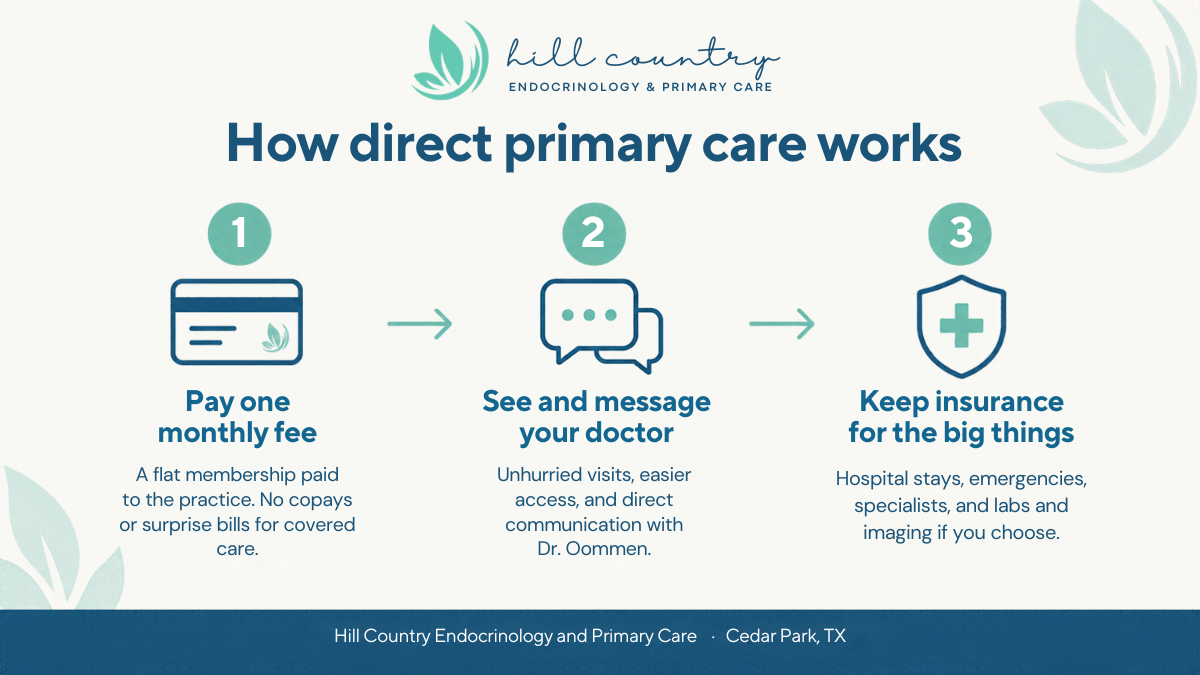
Instead of copays and claims, you simply pay one predictable monthly fee. That fee covers a defined list of primary care services, like office visits and managing ongoing conditions. Because the practice isn’t billing insurance for that care, the doctor can often offer longer visits and easier access. The AAFP says DPC gives patients “a greater degree of access to, and time with, physicians”.
That relationship is the whole point. Thomas Kim, MD, an Austin psychiatrist building a direct care practice, told Texas Medicine that “direct care has an enormous potential to restore the importance of that relationship” between patients and their doctors.
In Texas, a direct care agreement is not insurance. A 2025 state law renamed the model “direct patient care” and opened it to more types of practitioners, and the Texas Medical Association notes that these payment arrangements are still not an insurance product.
Key takeaway: With direct primary care, a flat monthly fee pays for your primary care, so you can see your doctor without copays or surprise bills for covered services.
What’s included and what isn’t
Every DPC practice sets its own list. At Hill Country Endocrinology and Primary Care, the family medicine membership is set up like this:
| Included in the membership | Not included (paid separately) |
|---|---|
| Office visits: well-child checks, sick visits, routine gynecological care, annual exams, and school, sports and camp physicals | X-rays, CT scans, ultrasounds and other imaging (the practice has access to reduced prices) |
| Chronic disease management | Blood and other tests sent to an outside lab (reduced prices available) |
| In-office tests | Surgery or procedures done outside the office |
| Direct communication with your doctor | Vaccine costs, prescriptions and injectable medications |
| Laceration repair and in-office procedures | Obstetric care and delivery, medical equipment such as crutches or walking boots |
| Hospital stays and emergency room visits |
Key takeaway: A membership covers the everyday care you get in the office. Imaging, outside labs, medications and hospital care cost extra.
Direct primary care vs. concierge medicine
The two terms often get mixed up. Jay Keese, executive director of the Direct Primary Care Coalition, told Medical Economics that concierge medicine typically charges for something insurance doesn’t cover, such as an executive physical. A direct primary care membership, by contrast, pays for your primary care itself, in place of billing insurance for it.
Key takeaway: Concierge medicine usually adds a fee on top of insurance. Direct primary care replaces insurance billing for your primary care.
Here is how the three ways of paying for primary care compare, based on the AAFP, Medical Economics and IRS Notice 2026-5:
| Direct primary care | Concierge medicine | Traditional insurance-based primary care | |
|---|---|---|---|
| How you pay | One flat monthly membership paid to the practice. No copays, coinsurance or deductibles, and no surprise bills | A membership fee, and your insurance is also billed for visits. You still pay copays, coinsurance and your deductible | Your insurance is billed per visit, and you pay copays, coinsurance or your deductible |
| Does the practice bill insurance for primary care? | No | Usually yes | Yes |
| Do you still need insurance? | Yes, for hospital stays, emergencies and specialists. It can also be used for labs and imaging | Yes | It is your coverage |
| Paying with an HSA in 2026 | Membership fees can be paid from an HSA within IRS limits ($150 a month for one person, $300 for more than one) | Check with your HSA administrator | Copays and deductibles are generally HSA-eligible expenses |

What does direct primary care cost in Cedar Park?
At Hill Country Endocrinology and Primary Care, memberships are $125 a month for an adult, $225 for a couple, $79 for a child and $399 for a family of two adults and two children. Other options include $239 for a single parent and two children, $149 for adults 65 and older without Traditional Medicare, and $59 for each child beyond two. There is a one-time enrollment fee of $125 per person or $200 per family. Dr. Oommen accepts Traditional Medicare for primary care; everyone else joins through a membership. (Prices as listed on the Family Medicine page in October 2026.)
Can you use an HSA for direct primary care? What changed in 2026
Yes, in most cases. Since January 1, 2026, a direct primary care membership no longer stops you from contributing to a health savings account, and you can pay the membership with HSA money, as long as the fee stays under a monthly limit. According to IRS Notice 2026-5, the limit is $150 a month for one person, or $300 for an arrangement that covers more than one person. The IRS will adjust it for inflation after 2026.
Here’s how this practice’s memberships compare with that limit:
| Membership | Monthly fee | 2026 HSA limit | Within the limit? |
|---|---|---|---|
| Adult | $125 | $150 | Yes |
| Child | $79 | $150 | Yes |
| Adult 65+ without Traditional Medicare | $149 | $150 | Yes |
| Couple | $225 | $300 | Yes |
| Single parent and 2 children | $239 | $300 | Yes |
| Family (2 adults, 2 children) | $399 | $300 | No |
A few details matter. The same IRS notice says bronze and catastrophic plans bought through the Health Insurance Marketplace now count as HSA-eligible plans, which helps if you’re self-employed. If your employer pays the membership fee, your HSA can’t reimburse it. The notice doesn’t say how one-time enrollment fees are treated. Because everyone’s situation is different, check with your HSA administrator or tax advisor before you rely on this.
Key takeaway: In 2026, most individual and couple memberships at this practice fall within the IRS limit, so HSA funds can usually pay for them.
Do you still need health insurance?
For most people, yes. The AAFP notes that most DPC patients “still carry insurance” for care such as specialists and hospital stays. A membership doesn’t cover emergencies, hospitalization or specialty care, so a health plan protects you from those big costs. Some people pair a membership with a high-deductible or marketplace plan. In an emergency, always call 911.
Key takeaway: Direct primary care covers your everyday care. Keep insurance for emergencies, hospital stays and specialists.

Is direct primary care right for you?
Direct primary care tends to suit people who want time with a doctor who really knows them. It’s worth a look if you:
- manage an ongoing condition such as diabetes, high blood pressure or thyroid problems and want regular follow-ups
- have a high-deductible plan or are self-employed and pay for most primary care yourself
- want one practice for the whole family, from well-child checks to annual exams
It may be less useful if your current plan already covers primary care with low costs and you’re happy with how quickly you can be seen, or if most of your care comes from specialists.
At Hill Country, primary care and endocrinology are in the same practice. If you have diabetes, thyroid or hormone concerns, that means your family doctor and your endocrinologist, Dr. Andrea George, can work together under one roof. Endocrinology members can add primary care for $99 a month.
“Direct Primary Care allows me to serve my patients directly, without middle-man barriers dictating the quality or pace of your care. It gives us the freedom to schedule unhurried visits, offer prompt access when you need it most, and focus entirely on your long-term health goals. My goal is to make managing your healthcare simple, personal, and stress-free.”
Shibu Oommen, MD, family medicine physician at Hill Country Endocrinology and Primary Care

How to join
Hill Country Endocrinology and Primary Care is at 13625 Ronald Reagan Blvd, Building 4, Suite 300, Cedar Park, TX 78613. Dr. Shibu Oommen leads the practice’s family medicine and direct primary care membership. To ask what’s included or to sign up, call or text the practice at (512) 522-3009, or contact us online.
Medically reviewed by Shibu Oommen, MD, a board-certified family medicine physician at Hill Country Endocrinology and Primary Care. Dr. Oommen completed his family medicine residency through Nebraska Medicine and formerly served as a Clinical Assistant Professor of Medicine at Creighton University School of Medicine.
This article is for general information only. It isn’t medical, tax or legal advice. Talk with your doctor about your health, and with your HSA administrator or a tax advisor about your HSA.
FAQ
Is direct primary care the same as health insurance?
No. Direct primary care is a membership that pays for primary care visits and services at one practice. Texas law treats a direct care agreement as not insurance, and it does not cover hospital stays, emergency care or specialists. Most members keep a health plan for those.
Can I use my HSA to pay for direct primary care?
Since January 1, 2026, you can generally use HSA funds for a direct primary care membership, and having one no longer blocks you from contributing to an HSA. The fee must be $150 a month or less for one person, or $300 or less for an arrangement covering more than one person. Check the details with your HSA administrator or tax advisor.
How much does direct primary care cost at Hill Country Endocrinology and Primary Care?
Memberships are $125 a month for an adult, $225 for a couple, $79 for a child and $399 for a family of two adults and two children. There is a one-time enrollment fee of $125 per person or $200 per family. Prices are listed on the practice’s Family Medicine page.
What is the difference between direct primary care and concierge medicine?
Direct primary care replaces insurance billing for your primary care with one flat monthly fee. Concierge medicine usually charges a fee for extras on top of the care your insurance already pays for. Both aim to give you more time and easier access to your doctor.
Does Hill Country accept Medicare for primary care?
Yes. Dr. Oommen accepts Traditional Medicare for primary care. Patients without Traditional Medicare join through a membership, including a $149 a month option for adults 65 and older.
